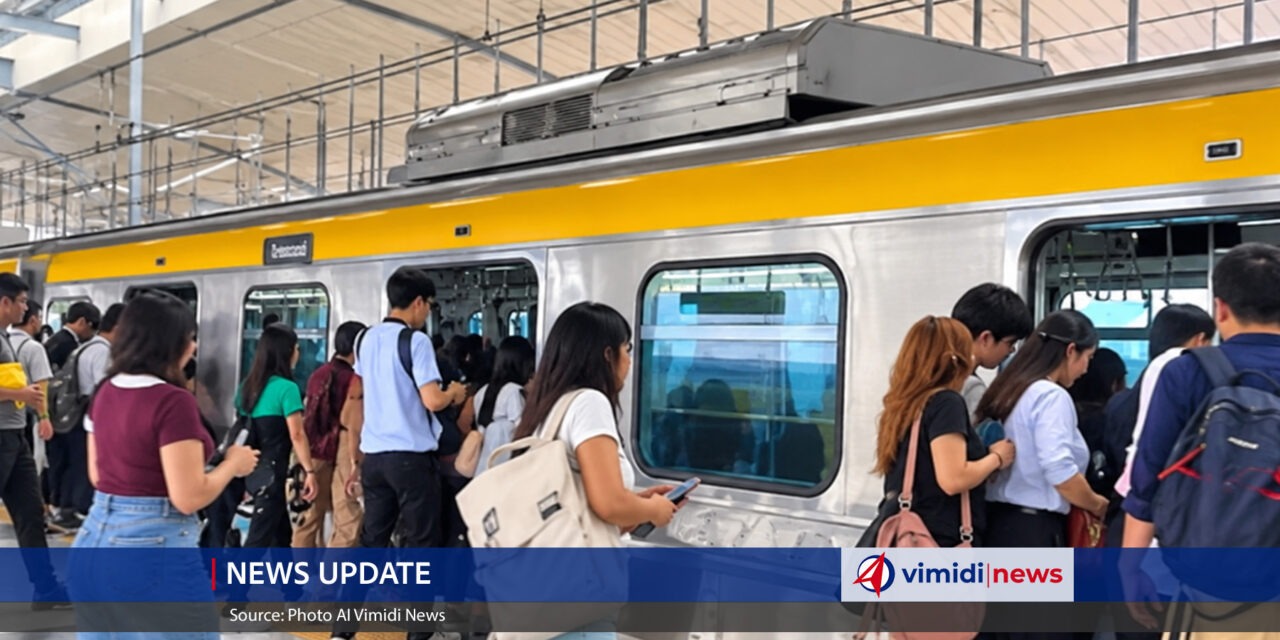
The Department of Transportation (DOTr) on Wednesday, November 4, launched a bus augmentation program to ease overcrowding and accommodate the growing number of commuters using the Light Rail Transit Line 2 (LRT-2).
Transportation Secretary Vince Dizon announced the deployment of 20 buses as an immediate measure to address the increasing passenger volume, particularly during peak hours. The buses will serve routes from Antipolo to Cubao, with some extending to Legarda to provide additional transportation options for passengers traveling along the railway corridor.
Dizon explained that the LRT-2 is struggling to accommodate the growing number of commuters due to its limited operational capacity. He disclosed that only 10 trains are currently running, as several others remain unavailable because of maintenance problems, insufficient funding, and aging equipment.
According to the transportation chief, the railway’s trains are already approximately 25 to 27 years old and have not been replaced, further affecting the system’s ability to meet increasing passenger demand. He emphasized that the current number of operational trains is insufficient to accommodate the volume of commuters, especially during rush hours.
To provide an alternative, the newly deployed buses can accommodate up to 70 passengers each, including those standing. The regular fare from Antipolo to Legarda is ₱80, while students are entitled to a discounted fare of ₱55.
The DOTr said the bus augmentation program would undergo an indefinite trial operation, which began on Wednesday. The initiative aims to reduce pressure on the LRT-2 while the government works on longer-term solutions to improve railway services.
Aside from the bus deployment, Dizon revealed that the agency is also studying the possibility of implementing an EDSA Busway-style system along Marcos Highway to further improve public transportation and commuter mobility in the area.
Meanwhile, plans to establish a Public-Private Partnership (PPP) arrangement for the LRT-2 remain underway. Dizon clarified that the proposed partnership would focus on railway operations and maintenance rather than increasing passenger fares.
He stressed that the government would retain control over fare regulation, assuring commuters that the PPP arrangement would not automatically result in higher ticket prices.
The proposed partnership is expected to improve the efficiency of railway operations, accelerate train procurement, and strengthen maintenance services.
The DOTr’s bus augmentation program serves as a temporary measure to address the LRT-2’s capacity limitations while the agency pursues improvements aimed at providing more reliable, efficient, and accessible public transportation for commuters.